← scenarios · two pilots, one smaller board — playable since version 3.1 (rule 4 changed in 3.1.1)
Scenario devised by P. Dols
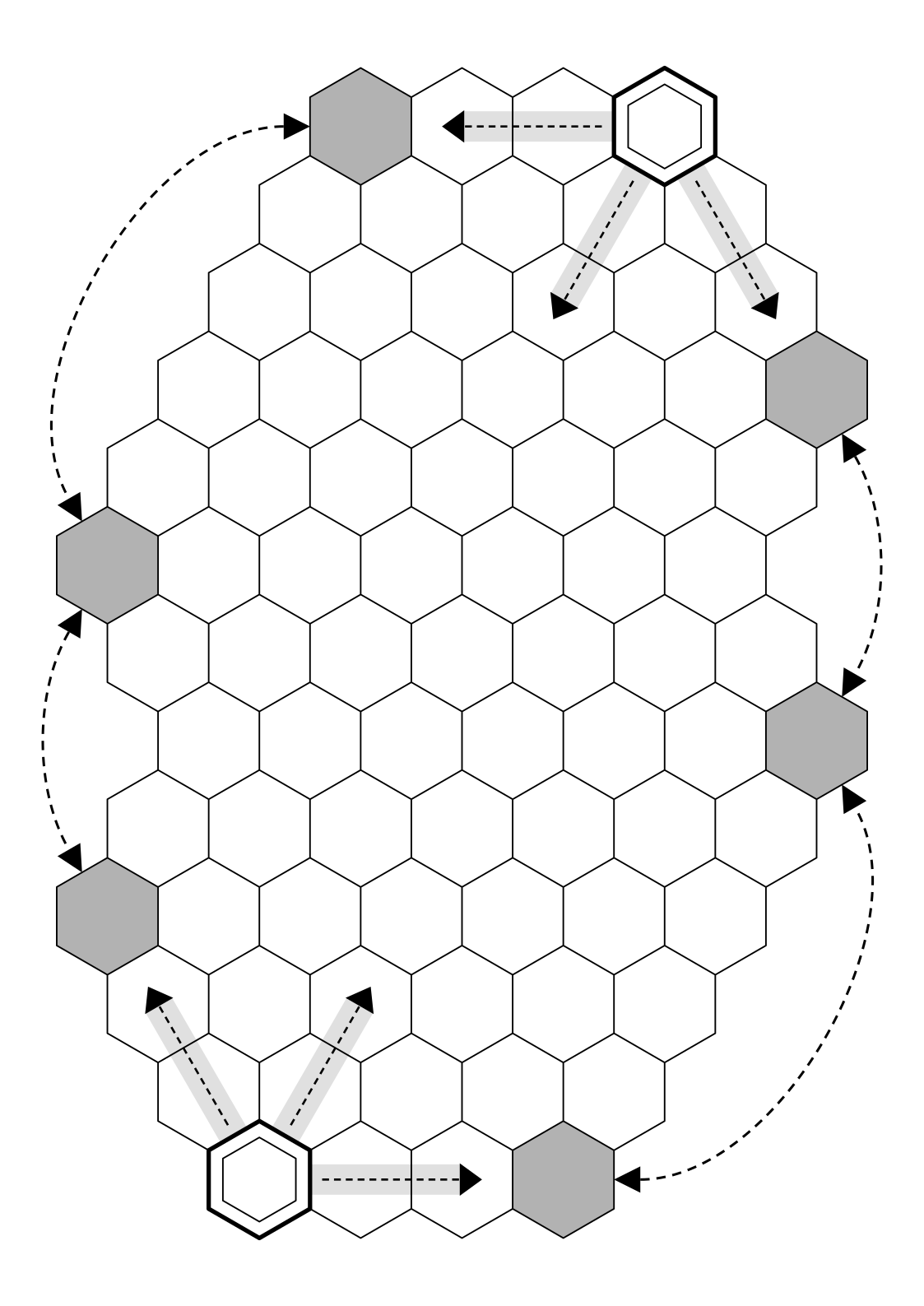
The duel is a variant for exactly two pilots, on a board of its own with 79 hexes, in the shape of an elongated airspace. All the normal rules apply, with the exceptions below. The main difference is that you do not leave this board the usual way: dotted lines along the edge, which you follow automatically when you fly nose-first over them, keep you from being forced off it.
Signing up. For a duel you sign up separately, by e-mail to contact at tweedekker1916.eu. The normal sign-up form on the front page is for the game with six pilots. Say in your mail that you want to play a duel; the game master finds an opponent for you and sets up the game.
Airfields and runways. Pilot 1 has the airfield at the top right, pilot 2 the one at the bottom left. Each airfield has the usual three runways α, β and γ, three hexes long including the field itself. They point into the board: one runs along the edge, one diagonally towards the middle and one diagonally the other way. The board is point-symmetric: turn it half a turn and each pilot sees exactly the same thing.
Print it yourself. The board can be downloaded and printed, white with black lines, on A3 portrait: pdf · svg. It shows the grey hexes, the dotted lines with their arrows and the airfields with their runways.
1. Clouds: eight hexes. There are eight cloud hexes on the board, in fields of two to four hexes (on the normal board there are thirty, in fields of three to five). More would make this smaller board too crowded. Otherwise they behave as always: they drift with the wind, new cloud blows in when too little is left, and flying through a cloud costs one damage point per move.
2. Equal equipment. Both pilots fly as beginners, with the standard starting equipment: three moves a turn, sixteen bursts, sight range of four hexes. Your career does not take part in a duel. What you earned in games with six pilots stays yours, but you do not bring it along, and nothing is added.
3. Grey hexes. Six hexes are grey. These are the hexes where an aircraft with the right heading is in trouble: all three possible forward moves (straight, forward-left, forward-right) leave the board, as in a corner of the normal board. At least one dotted line with an arrow starts at every grey hex.
4. The dotted line follows automatically. If you fly nose-first through a hex side where a dotted line starts, you follow that line automatically: you fly, as it were, straight on across the line and arrive in the grey hex at the other end, through the hex side with the arrow, with your nose pointing straight into that hex. You do not have to order anything for this. It counts as one ordinary move; you may fire after it as after any move, and cloud damage applies on arrival.
Which moves follow the line? Straight, Turn left and Turn right. With a turn you turn first and then fly forward, so your nose points in the direction in which you cross the side. Slip left and Slip right never follow a dotted line: a slip goes sideways, without turning, so it does not take you “forward” across the line. There is therefore no slip that takes the line. Example: if your aircraft is on an edge hex and Turn right takes you across the dotted line, then Slip right, to the same hex side, flies you off the board.
Anyone who sends in no orders (NMR) flies straight ahead and therefore follows a line that lies straight in front of their nose. You only fly off the board through a side without a dotted line, or with a slip. On the order form, moves that follow the line say: “follows the dotted line”.
The four dotted lines. Counting rows from top to bottom, 1 to 13:
So there are two chains of three hexes. The middle one of each chain has two exits. If you are in the grey hex on the left in row 6 with your nose pointing west, Turn right (towards the northwest) takes you across the line to the top grey hex, and Turn left (towards the southwest) takes you across the line to the grey hex on the left in row 10. Straight ahead to the west has no line: that is off the board. Slip left and Slip right go to the same hex sides as those turns, but fly you off the board. Every aircraft that risks disappearing from a grey hex has at least one way out. After arriving there is always a hex on the board ahead of you.
5. Firing. Firing works as always, including towards the edge of the board. But a bullet never follows the path of a dotted line: a burst stops at the edge of the board and does not come out at the other end. So you cannot shoot across a line at an aircraft.
6. Airfields. Taking off and landing work as always. The two corner hexes with the airfield itself have no dotted line. If you fly over one without landing, and every forward move leaves the board, you fly off the board, just as in a corner of the normal board.
7. Who wins? The last pilot left. If you are out because of twelve damage points, or because you fly off the board, you have lost. If both drop out in the same turn, it is a draw. A duel is played in turns of three moves, just like a normal game.
A duel does not count towards your career. There is a standing of its own instead, which you only see here. A win gives 2 points, a draw 1 and a loss 0. If the standings are level, the number of hits decides, then the number of wins. Only duels between two real pilots count: a practice duel against the computer does not.
No duel has been finished yet.
Back to the scenarios page, or to the normal rules for the game with six pilots. Want to request a duel, or have an idea for this scenario? Mail contact at tweedekker1916.eu.
This site uses technical cookies only, among them one to remember which language you read in. The server does count how many different visitors the home page gets per day, per week and per quarter, but it does so with a code from which no individual visitor can be identified and which is kept for three months at most; there are no third-party cookies, and nothing goes to advertisers. Read the privacy statement.